Customer expectations are rising faster than ever. People now expect instant answers, personalized help, and seamless experiences on every channel they use. That is exactly where conversational AI customer service shines.
By implementing AI-driven solutions, businesses can unlock the business advantages of AI in call centers while delivering smarter, faster support. According to a Talk Business article on AI-driven customer experience, leveraging conversational AI allows teams to reduce wait times, handle repetitive queries efficiently, and provide always-on assistance across multiple channels. The result: happier customers, more productive agents, and a support operation that can scale seamlessly without overburdening your team or budget.
Advanced computing frameworks are crucial for powering AI interactions. Businesses are increasingly turning to FlashMob Computing – distributed processing solutions to ensure real-time, efficient responses for customer queries. High-performance computing resources from Supercomputer Box – accelerated AI systems allow enterprises to handle massive datasets and deliver instant support without lag.
In customer engagement, personalization and insight-driven strategies are essential. Tools from Marketing for Customers – AI-powered customer interaction strategies help teams tailor responses based on behavior, while Marketing Runners – data-driven marketing solutions optimize outreach campaigns that complement AI-driven customer support.
Financial planning and analysis can also benefit from advanced AI applications. Accessing Top Financial Resources – predictive analytics for smarter business decisions helps organizations anticipate trends, allocate budgets efficiently, and maintain seamless customer service without compromising operational efficiency. Integrating these technologies ensures that AI support is not only fast but also accurate and context-aware.
Ultimately, implementing conversational AI in customer service goes beyond automation. By combining high-performance computing, intelligent marketing insights, and predictive financial analytics, businesses create interactions that feel personal, efficient, and highly responsive, giving customers the support they expect and deserve.
Top 10 Contact Center Solutions for Conversational AI Customer Service
Choosing the right contact center solution is crucial for delivering seamless support, reducing response times, and improving overall customer satisfaction. Here’s a list of the top platforms to consider, with Bright Pattern leading the way.
1. Bright Pattern – AI-Powered Contact Center Solutions
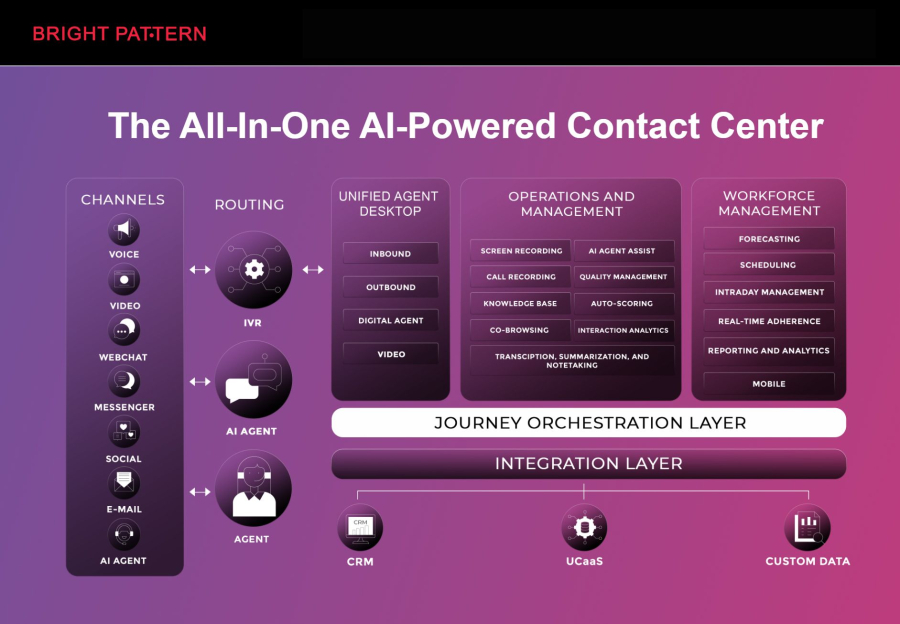
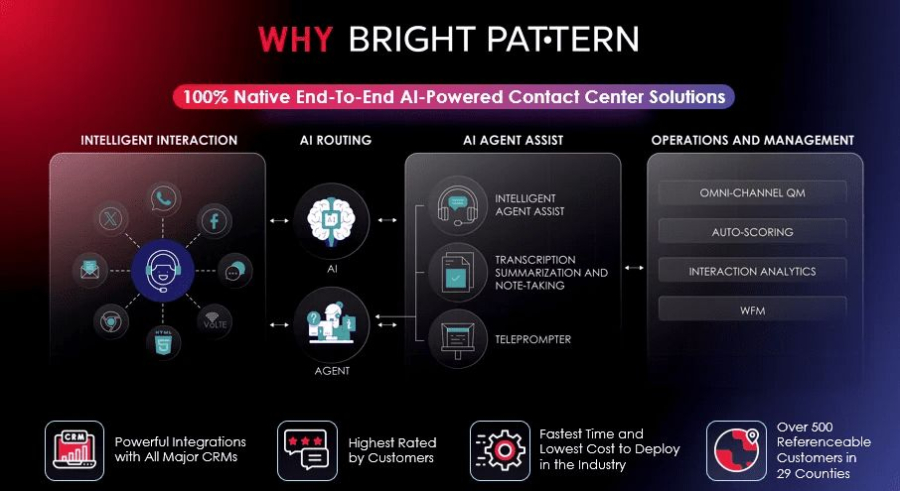
Bright Pattern is a leading provider of conversational AI customer service solutions, offering a flexible, cloud-based platform that connects customers with agents across multiple channels. Its advanced AI capabilities ensure faster response times, personalized interactions, and improved operational efficiency.
Key features of Bright Pattern include:
- Omnichannel support across voice, chat, email, SMS, and social media
- Intelligent routing and AI-assisted agent guidance
- Automated workflows and AI-driven chatbots for repetitive tasks
- Real-time analytics and reporting for performance insights
- Scalable architecture suitable for businesses of all sizes
Bright Pattern is designed to help companies modernize their call centers, providing smarter, AI-driven solutions that enhance both agent productivity and customer satisfaction.
2. Genesys – Customer Engagement and AI Solutions
Genesys offers cloud-based contact center platforms with conversational AI capabilities, enabling businesses to provide personalized support at scale. It focuses on agent-assisted AI, predictive routing, and automated self-service.
3. RingCentral – Cloud Contact Center Platform
RingCentral provides a cloud contact center that integrates AI to improve customer experiences. Features include omnichannel support, real-time analytics, and AI-driven insights to optimize agent performance.
4. 8x8 – AI Contact Center Services
8x8’s contact center solutions leverage conversational AI to deliver intelligent routing, speech analytics, and automated interactions, helping companies reduce operational costs and improve customer satisfaction.
5. Talkdesk – Modern AI-Powered Call Center
Talkdesk combines AI-driven workflows, real-time insights, and automated self-service tools to streamline customer support. Its platform enables faster response times and consistent service across channels.
6. NICE inContact – Customer Experience AI Solutions
NICE inContact focuses on AI-assisted customer service with predictive analytics, omnichannel support, and automated workflow management. Its solutions help call centers operate efficiently while delivering better customer experiences.
7. Cisco Contact Center – Intelligent Service Platform
Cisco Contact Center provides AI-enabled features for routing, self-service, and agent assistance. Its platform emphasizes reliability, scalability, and seamless integration with enterprise systems.
8. Avaya – Advanced Contact Center Software
Avaya offers a comprehensive AI-driven contact center platform that supports voice, chat, email, and messaging channels. Its intelligent automation and analytics help businesses improve efficiency and customer engagement.
9. Mitel – Cloud Contact Center Solutions
Mitel’s cloud-based contact center solutions provide AI-enhanced routing, performance analytics, and workflow automation, helping organizations deliver faster and more personalized customer service.
10. Salesforce Service Cloud – AI Customer Service Platform
Salesforce Service Cloud integrates AI-powered chatbots and predictive analytics to streamline customer support. It provides omnichannel engagement and actionable insights to improve agent productivity and satisfaction.
What Is Conversational AI in Customer Service?
Conversational AIrefers to technologies that allow computers to understand, process, and respond to human language in a natural, conversational way. In customer service, this often takes the form of:
- AI chatbotson websites or inside apps
- Virtual agentsin messaging channels like SMS or chat tools
- Voice assistantsin call centers and IVR systems
These AI-powered assistants can answer questions, troubleshoot issues, complete tasks, and hand conversations over to human agents when needed. Unlike traditional rule-based bots that rely on rigid decision trees, conversational AI uses natural language understanding to interpret the intent behind a message, even if the customer phrases it in an unexpected way.
Why Conversational AI Is Reshaping Customer Support
When done well, conversational AI becomes a powerful extension of your customer service team rather than a simple FAQ bot. Here are the most important benefits businesses see when they implement it.
1. 24/7 Availability Without 24/7 Staffing
Customers do not operate on business hours, and neither should your support. Conversational AI providesround-the-clock assistancewithout requiring overnight shifts or costly overtime.
- Answer common questions at any time of day.
- Handle time-sensitive tasks like order tracking or password resets instantly.
- Offer reassurance during off-hours and automatically schedule follow-ups with human agents when needed.
This constant availability boosts customer satisfaction while giving your team the freedom to focus on high-value interactions during their working hours.
2. Faster Resolutions and Shorter Wait Times
One of the biggest frustrations for customers is waiting—on hold, in queues, or for email responses. Conversational AI tackles this head-on by providinginstant first responsesand guiding customers toward solutions in real time.
- Resolve routine issues (like billing questions or simple troubleshooting) in seconds.
- Deflect repetitive inquiries away from human agents, freeing them to focus on complex cases.
- Reduce average handle times when handoffs do occur by pre-collecting information.
The result is a smoother experience for customers and a less chaotic environment for agents.
3. Personalization at Scale
Modern conversational AI can integrate with CRM, order management, and account systems to delivercontext-aware, personalized support. Instead of generic answers, customers get help tailored to their specific situation.
- Recognize returning customers and reference their history.
- Use data like recent orders, subscription details, or support tickets to give precise answers.
- Offer proactive suggestions based on patterns (for example, common follow-up questions).
Personalization makes interactions feel more human, even when they are AI-driven. Customers feel understood, not just processed.
4. Lower Costs with Higher Productivity
Scaling a traditional customer service operation usually means hiring more people. Conversational AI changes that equation by allowing you tohandle more volume with the same (or smaller) team.
- Automate high-volume, low-complexity queries that dominate most support queues.
- Let agents focus on escalations, relationship-building, and complex problem solving.
- Reduce training time by using AI to guide agents with suggested responses and knowledge snippets.
Instead of replacing humans, conversational AI augments them, removing repetitive tasks so they can contribute where human skills matter most.
5. Consistent Answers Across All Channels
Customers often get inconsistent answers depending on which agent they speak to or which channel they use. Conversational AI helps enforce asingle source of truthacross your support ecosystem.
- Standardize responses based on your latest policies and knowledge base.
- Ensure both AI agents and human agents draw from the same information.
- Maintain brand voice and tone in every response.
Consistency builds trust. When customers know they can rely on you for clear, accurate answers every time, loyalty grows.
6. Rich Data and Actionable Insights
Every customer interaction contains valuable feedback. Conversational AI makes it easier tocapture, analyze, and act on that data at scale.
- Identify the most common questions and friction points in the customer journey.
- Discover gaps in your self-service content and knowledge base.
- Spot product issues early from recurring complaints or requests.
These insights support better decision-making across product, marketing, and operations—not just customer service.
Key Use Cases for Conversational AI in Customer Service
Conversational AI can be tailored to many stages of the customer lifecycle. Here are some of the most impactful use cases.
- Pre-sales support– Answer product questions, compare options, and guide customers to the right choice.
- Onboarding and activation– Walk new customers through setup steps or account creation.
- Order and account management– Check order status, update personal details, or manage subscriptions.
- Technical troubleshooting– Diagnose common issues and suggest step-by-step fixes.
- Billing and payments– Clarify charges, share invoices, or help with payment methods.
- Proactive notifications– Notify customers about delays, renewals, or service changes and answer follow-up questions.
- Feedback and surveys– Collect ratings and comments in a conversational, low-friction way.
In each scenario, conversational AI helps you meet customers exactly where they are, with the right support at the right time.
How Conversational AI in Customer Service Actually Works
Behind every smooth interaction is a coordinated set of technologies. While implementations vary, most conversational AI systems for customer service share a few core components.
1. Natural Language Understanding (NLU)
NLU is the part of the system that tries to understand what the customer means. It extracts:
- Intent– The goal behind the message (for example, "track my order" or "reset my password").
- Entities– Key details such as order numbers, dates, product names, or locations.
The better the NLU, the more flexible the system can be in understanding different wording, spelling errors, or slang.
2. Dialogue Management
Dialogue management controls the flow of the conversation. It decides:
- What the AI should ask or answer next.
- When to request more information.
- When to escalate to a human agent.
Well-designed dialogue flows feel natural and responsive, guiding the customer smoothly toward a solution without making them repeat themselves.
3. Integrations with Your Systems
To be truly useful, conversational AI must connect to the tools you already use, such as:
- CRM and customer databases.
- Order management and logistics systems.
- Billing and subscription platforms.
- Ticketing and help desk software.
These integrations allow the AI to access real-time information, personalize responses, and update records during the conversation.
4. Machine Learning and Continuous Improvement
Modern conversational AI systems improve over time. They can learn from:
- New examples of how customers phrase questions.
- Agent corrections or overrides.
- Feedback and satisfaction scores after conversations.
With ongoing training and optimization, the system becomes more accurate, more helpful, and more aligned with your brand voice.
Steps to Get Started with Conversational AI in Customer Service
Successfully adopting conversational AI is less about technology and more about thoughtful design. Here is a practical roadmap.
Step 1: Define Clear Objectives
Start by clarifying what you want to achieve. Examples include:
- Reducing average response time by a specific percentage.
- Deflecting a portion of repetitive inquiries away from agents.
- Improving customer satisfaction scores for digital channels.
Clear goals help you prioritize use cases and measure success effectively.
Step 2: Identify High-Impact Use Cases
Review your existing support data to find quick wins. Look for:
- Questions that appear repeatedly in tickets or chats.
- Simple, rules-based processes that do not require complex judgment.
- Tasks where customers mainly need information or status updates.
Starting with high-volume, low-complexity topics builds momentum and demonstrates value quickly.
Step 3: Map Conversational Journeys
Design how conversations should flow for each use case. Consider:
- How the user might phrase the initial question.
- What information the AI needs to collect.
- How to confirm details and present solutions.
- What happens if the AI cannot resolve the issue.
Keeping the journeys simple and user-friendly at the start makes deployment smoother and feedback clearer.
Step 4: Prepare and Structure Your Knowledge
Conversational AI is only as strong as the information it can access. Invest time in:
- Updating your knowledge base and FAQs.
- Structuring content so it is easy to retrieve and reuse.
- Aligning support content with your current policies and product features.
Well-prepared content enables accurate, consistent responses from day one.
Step 5: Pilot, Learn, and Expand
Launch your conversational AI in a focused area first, such as a specific channel or a subset of topics. Then:
- Monitor real interactions and customer feedback.
- Tune intents, responses, and flows based on what you see.
- Gradually expand coverage to more scenarios and channels.
This iterative approach reduces risk and ensures the system stays aligned with customer needs.
Best Practices for Successful Conversational AI Customer Service
To unlock the full potential of conversational AI, keep these practical best practices in mind.
1. Be Transparent About AI vs. Human
Customers appreciate honesty. Let them know when they are interacting with an AI assistant, and make it easy to reach a human when necessary. Transparency builds trust rather than eroding it.
2. Design for Handovers, Not Just Automation
Even the best AI will not solve 100% of issues. Plan for smooth, low-friction handoffs to agents by:
- Passing conversation history and collected data to the agent.
- Allowing customers to request a person at any point.
- Ensuring agents can see what the AI has already tried.
This keeps customers from repeating themselves and preserves continuity in the experience.
3. Keep Language Simple and Human
Even though the system is powered by AI, the tone should feel friendly and clear. Use:
- Short sentences and everyday words.
- Positive, solution-oriented phrasing.
- Polite confirmations and summaries so customers feel heard.
Simple language helps the AI avoid misunderstandings and makes conversations feel more natural.
4. Continuously Train and Optimize
Conversational AI is not a "set and forget" tool. To keep quality high:
- Regularly review transcripts to identify new intents and edge cases.
- Refine responses based on what resonates with users.
- Include frontline agents in the feedback loop— they know customer pain points best.
Ongoing optimization ensures the system evolves along with your products, policies, and customers.
5. Protect Customer Data and Privacy
Customers will only fully embrace AI-driven service if they trust that their information is handled responsibly. Make sure you:
- Limit access to sensitive data to what is genuinely needed.
- Follow applicable data protection and privacy regulations.
- Provide clear information about how data is used in AI systems.
Strong privacy and security practices turn conversational AI into a long-term asset rather than a risk.
Measuring the Impact of Conversational AI in Customer Service
To understand whether your conversational AI strategy is working, track a mix of efficiency and experience metrics. Common measures include:
- Containment rate– The percentage of interactions resolved entirely by AI without human intervention.
- Average response time– How quickly customers receive initial and follow-up answers.
- Resolution time– How long it takes to fully solve issues with AI, humans, or a combination.
- Customer satisfaction (CSAT)– How customers rate their experience after AI-assisted support.
- Agent productivity– Changes in tickets handled per agent and time spent on complex tasks.
- Cost per contact– The average cost to handle a support interaction across channels.
By regularly reviewing these metrics, you can fine-tune your strategy, demonstrate return on investment, and identify new opportunities to expand automation.
Future Trends in Conversational AI for Customer Service
Conversational AI is evolving quickly, bringing even more opportunities for service teams. Some emerging trends include:
- More natural, multi-turn conversations– Systems that remember context over longer sessions and handle complex back-and-forth dialogue.
- Deeper personalization– Responses tailored not just to account data but also to behavior patterns and preferences.
- Voice plus text convergence– Unified experiences whether customers call, chat, or message, all powered by the same AI brain.
- Proactive, predictive support– AI that anticipates issues before customers reach out, based on signals like usage data or known incidents.
- Closer collaboration between AI and agents– Real-time suggestions, summaries, and insights to help human agents perform at their best.
Organizations that start building strong conversational AI capabilities now will be well-positioned to take advantage of these advancements as they mature.
Bringing It All Together
Conversational AI is no longer a distant future technology or a novelty. It is a practical, high-impact way to elevate customer service today. By combining intelligent automation with human empathy, you can:
- Deliver instant, 24/7 support without sacrificing quality.
- Personalize every interaction based on real customer context.
- Empower agents to focus on meaningful, complex work.
- Control costs while still scaling to meet growing demand.
With a clear strategy, thoughtful design, and commitment to continuous improvement, conversational AI becomes more than just a chatbot. It turns your customer service operation into a smart, responsive, and truly customer-centric experience— one that keeps people coming back, again and again.
